what program to use to make secondlife items
Welcome to Animesh! Animesh is a new 2d Life feature to allow independent objects to use rigged mesh and animations, only as y'all can today with mesh avatars. This means that y'all tin now take wild fauna, pets, vehicles, scenery features and other objects that play animations.
Where it works
Animesh is supported in all regions of the master grid and on the examination grid. Currently Animesh works with the default viewer. If yous need a place to test animesh content, in that location are some dedicated test regions at Animesh1, Animesh2, Animesh3and Animesh4, which are gear up to moderate maturity, and Animesh Adult, which is intended for adult content. These regions also have a gift box which will requite you lot some exam/instance animesh objects. All the regions are publicly attainable. Items left in the regions will be automatically returned to you after 24 hours, and may be manually returned at any fourth dimension if we need to make changes to the exam areas.
Getting started
Visit i of the Animesh regions listed above and look around. Hopefully you will see some interesting animated objects! Gratis sample animesh items are available in all the examination regions; just click on the big gift box in the middle of whatsoever region.
The sample animesh objects are a velociraptor, a human, and a teddy carry. All of them can play their own animations and wander around the region using pathfinding. The teddy bear is too designed to be used as an attachment if you want to option it up.
The corresponding source files for upload tin can be constitute at BUG-139234
What's new with animesh
Making and unmaking animesh objects
The animesh viewer adds 1 new feature to the UI for editing an in-world object. If you lot correct click on an object and choose edit, y'all will meet a dialog for editing the object. In the features tab, there is a new checkbox labelled "Blithe Mesh". If the object is a rigged mesh, you lot tin can use the checkbox to plough it into an animesh object with its own skeleton. There are some restrictions: the object must be one you lot have permissions to modify, it must non exceed the maximum triangle count limit for animesh objects, and you must exist in an animesh-enabled region. If whatsoever of these status are non met then the checkbox volition not exist enabled.
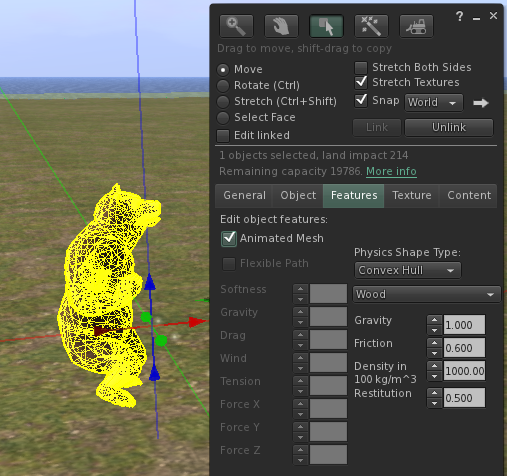
Animating animesh objects
When an object becomes animesh, it won't do annihilation right away. Y'all yet have to run animations on it. The way you lot practice this is to add together one or more animations to the object'due south inventory (using the Content tab) and then run a script that plays those animations.
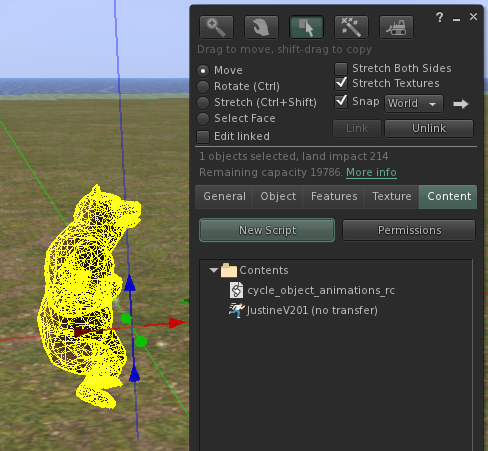
Here y'all can meet the animesh object contains one animation, and has a script that tin can run it.
Animesh adds three new LSL methods that can be used to run or finish animations, or bank check which animations are currently running. The commands are:
- llStartObjectAnimation
- llStopObjectAnimation
- llGetObjectAnimationNames
Details and examples on how to use the methods are given at those wiki pages.
Animesh position and orientation
A conventional static mesh object has a position defined when it'southward rezzed, and an orientation divers when it'southward created. An animesh object withal has an object position divers "nether the hood", but the displayed mesh is shown at a location determined past its underlying skeleton and currently playing animations. Because of this, the visual location of an animesh object playing an blitheness may be at some displacement from its "real" position for physics and scripting purposes. The skeleton is positioned relative to the original object as follows:
- The object position is used equally the location for the skeleton root joint.
- The object orientation matches the root object orientation. If the root object is a mesh, the bind shape matrix will be used.
- Playing animations tin modify the visual position and orientation farther by animative the pelvis articulation.
One result is that animesh objects will normally be oriented with their local X-axis as the forward direction. Static mesh objects are not necessarily created in this orientation, and so there may be a change in orientation when an object becomes animesh. However, if the root object of an animesh linkset is a mesh, the bind shape matrix will also be used. This ways that if you desire your object to be oriented relative to the static mesh representation, yous can employ an animesh root mesh. If y'all want your object to have standard X-forward skeleton orientation, you tin use a not-mesh root object (for case, a simple invisible prim) and then marshal your mesh kid objects relative to that.
An animesh object's real position and orientation can be edited using the standard editing controls (correct click the object and pick edit). Calibration changes can besides be made but have no consequence on the skeleton, and then are non reflected in the displayed mesh.
Position and Scale Constraints
At that place are some constraints on the scale and positioning of animesh objects. These are intended to maintain consistency with limits on other types of in-world objects (such equally conventional prims), and to make the behavior more predictable.
- In that location is a 64m scale limit for animesh objects. Objects exceeding this size threshold will be scaled down so their computed bounding box does non exceed 64m.
- There is a 3m showtime limit for animesh objects. Beginning is the distance between the "official" location of the static object and the bounding box of the animesh object as displayed. The brandish location of animesh objects will be constrained to non exceed this limit.
These constraints are based on a real-fourth dimension bounding box maintained for rigged meshes, and then they may be triggered at some times and not others depending on the animations being played. For performance reasons the box does not update every frame, so the constraints can lag behind the current appearance slightly.
Animesh building suggestions
Animesh objects exercise not take attachments the way avatars practise. To combine multiple meshes in a single animesh, y'all would link them together into a single linkset. If you link together multiple meshes, the original source meshes and any corresponding physics representations can exist scattered effectually multiple locations. The meshes will all still display rigged to a unmarried skeleton, with orientation equally noted above. The recommended practice for at present is to have a root prim that'due south not a rigged mesh, and associate any physics representation with that root prim. The rigged meshes would then be non-physical children of this root.
Also note that like rigged meshes on avatars, the rigged meshes in animesh objects are non-physical. The blitheness process merely affects how things display on the viewer, and then if you want to accept a physics shape that lines upwards with your animesh object, you lot will need to manage the positioning and animations appropriately.
Animesh attachments
Animesh objects tin also exist attachments on your avatar. Similar a conventional static attachment, an animesh attachment will move with the selected attachment point on your avatar, such as your right shoulder or left hand. Animesh attachments can and so run animations, which can change their apparent position relative to their attachment bespeak (for example, if the pelvis joint is part of the animation).
Like static attachments, animesh attachments can exist repositioned using the editing controls. Changing position or rotation will move the attachment relative to its zipper bespeak.
Currently you can take at most one animesh zipper at a time.
Animesh Skeleton Land and Customization
Avatars support extensive customization via sliders. The basic in an avatar skeleton are positioned and scaled based on these customization settings, which are stored generally in the avatar'due south shape wearable. Animesh objects do not currently support this type of customization; they do non have shape wearables, then there is no way to do the aforementioned kind of skeleton customization for them. The bone positions and scales for an animesh object are simply initialized from the default os settings (defined in some configuration files that are part of the viewer installation - avatar_skeleton.xml and avatar_lad.xml). These default bone positions and scales tin be overridden in the uploaded meshes, using values defined when the meshes were created. This is the same joint position mechanism that rigged meshes tin can also apply to customize avatar positioning.
We know in that location is a lot of interest in supporting more extensive customization of animeshes, and are hoping to tackle this in a later project.
New and updated displays
Some additional displays are available to help you come across the state of animesh objects:
- In the Avant-garde bill of fare, the choice Performance tools->Show avatar complication information lets y'all see the computed complexity toll for avatars. This display has some boosted information added to it, and at present works for animesh objects besides.
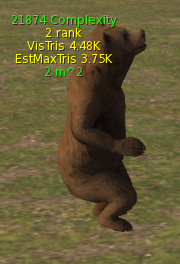
Here you can come across the updated display, applied to an animesh object. VisTris is the number of currently displayed triangles associated with the object, based on the currently displayed LODs (levels of detail) for its component primitives. EstMaxTris is an estimated triangle count for the most circuitous LODs of the object; this is the number used to determine whether an object exceeds the triangle count complexity limit for animesh objects. The complexity display only works for avatars and independent animesh objects. Attached animesh objects have their complexity added to the avatar they are fastened to, so they are not shown with a complication display of their own.
- Another updated display is Develop->Render Metadata->Collision skeleton. This volition bear witness the collision volumes for animesh objects equally well as avatars, with the animesh objects shown a unlike color:
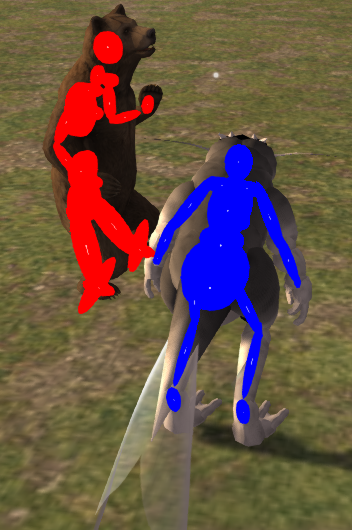
Hither the avatar has a blue skeleton, and the animesh has a red one.
- Develop->Render Metadata->Joints will show the regular bones in the skeleton of both avatars and animesh objects.
Both of the Render Metadata displays have a significant performance touch, and then you will probably non want to enable them most of the time.
Known bug and bugs
- Animesh shadows practise not accept alpha into business relationship. This is a general graphical event with how we display rigged meshes, then it's the aforementioned equally what you lot would run into if the same meshes were attached to your own avatar. This is an issue that nosotros are aware of and hope to set at some point, simply it's not role of the Animesh project.
- Some types of editing in the build floater do not piece of work correctly with animesh objects.
Warnings
Objects you place in the examination regions may be deleted or returned at any time. Please keep a re-create of all your work in progress.
FAQ
What happens if I have an unsupported viewer?
If you visit an animesh-enabled region with a not-animesh viewer, you will run into animesh objects as non-blithe static mesh objects, and animesh attachments as rigged meshes on the host avatar.
What happens if I visit unsupported regions and try to use animesh content?
This state of affairs should non come upwardly now that animesh support is enabled on the main grid. If you lot do meet a region, perhaps on the test grid, that lacks animesh support, then animesh objects will not piece of work correctly. Scripts that try to utilise the new animesh LSL functions volition requite an error message if run in a not-animesh region. Once you render to an animesh region you may need to reset the script to get it working once again.
How can report a bug or request new features?
Please report the bug using the standard JIRA process, and include [ANIMESH] in the title.
How can I appoint with other users of animesh?
- Visit the content creation forum expanse for animesh: https://customs.secondlife.com/forums/forum/354-animesh/. Linden Lab will monitor this area while animesh is under development, and we will try to respond to questions of general interest.
- Attend the Content Creation User Grouping coming together, which is held most weeks on Thursday. All are welcome. See https://wiki.secondlife.com/wiki/Content_Creation_User_Group for location and schedule data.
Volition whatsoever pre-animesh content change?
No. Animesh is a new setting for mesh objects. Whatever content created without that setting should go on to work the same equally before. If you meet whatsoever modify in the behavior of not-animesh objects, please report it as a bug.
What's the deviation between an animesh attachment and a regular rigged mesh attachment? When should I use ane or the other?
Animesh attachments have a consummate skeleton of their own, so they can motility completely independently from your avatar. For example, an animesh fairy could flap its own wings separately from the wings on your avatar (this besides means that animations between animesh objects and your own avatar may non be completely in sync, since they are animated independently). An animesh attachment tin can also become an independent object if it is detached. Regular mesh attachments employ your avatar's skeleton, so if they want to animate any office of your avatar they accept to cooperate with other attachments. There are some cases where yous could use either an animated zipper or a rigged mesh: if the object uses joints that are non being used for anything else, for case, it animates the wing basic of an avatar that does not have wings, then this could be implemented using either a regular rigged mesh attachment or an animesh zipper.
Are in that location any restrictions on animesh content?
The current limits are intended to assistance manage the performance costs associated with animesh objects:
- There is a limit to how many animesh objects can be attached to an avatar at ane time. Currently this is a maximum of one, two for premium subscribers.
- Animesh objects in-globe (ie, not attached to an avatar) volition have a state touch that counts against the limits for the region they are in. Currently beingness animesh adds an boosted fifteen to the land impact of an object. There is an additional country touch on cost of 1.v per one,000 charged triangles in the model. All triangles in the highest LOD are charged, but simply triangles exceeding a limit are charged in the coarser LODs; there is no LI penalty for LODs equally long as each does not exceed half the complexity of the next highest level - for example, if the highest LOD has 10,000 triangles, you could make LODs with no penalisation up to 5,000 triangles in the medium LOD, 2,500 in the low LOD, and 1,250 in the everyman LOD. LODs that exceed those limits will be counted confronting the LI only for whatever backlog to a higher place those limits.
- Animesh objects have a complexity limit based on triangle count. Currently an animesh object can have at most 100,000 triangles in its most detailed LOD. This 100,000 limit is based on estimated triangle count, so the actual number of triangles can often exist a bit higher.
- Attached animesh objects, like other attachments, do not count confronting land impact. However, they practice affect the Avatar Rendering Cost calculations for the avatar they are fastened to. The ARC for animesh objects, like the ARC for avatars, incorporates the furnishings of graphics properties of the mesh objects, and is scaled to be roughly proportional to the land impact - for instance, if an animesh object has fifty% higher country bear on than the respective static mesh, then the ARC for that animesh should also be roughly 50% higher.
Additional resource
Here are a few links to resources related to animesh:
- Second Life Web log: Animesh is Here!
- Content Creation User Group
- Content creation forum area for animesh
mclaughlinsplaccut.blogspot.com
Source: https://wiki.secondlife.com/wiki/Animesh_User_Guide
0 Response to "what program to use to make secondlife items"
Postar um comentário